
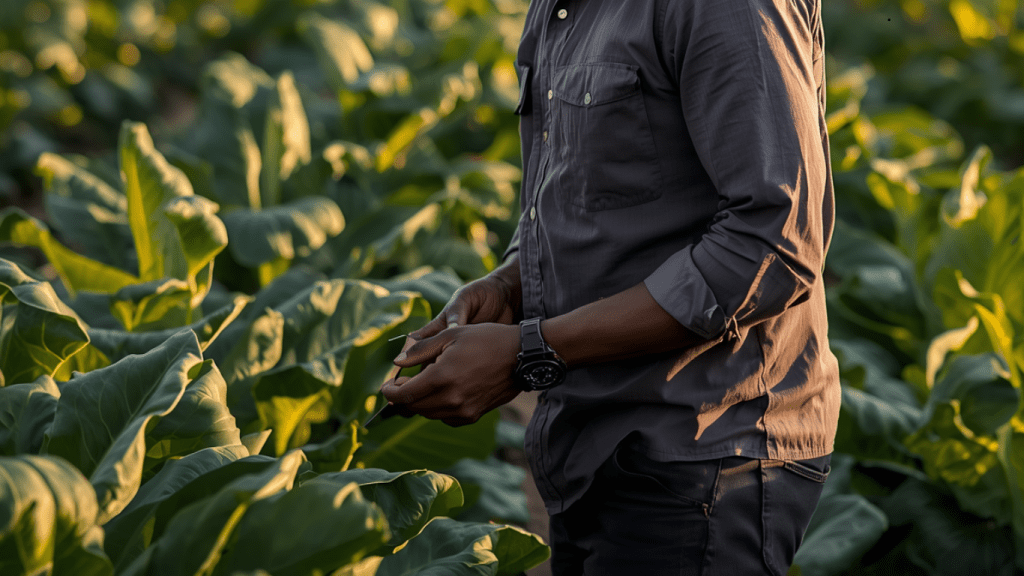
On a hot Tuesday morning in Mhangura, a young agronomist named Tawanda parks his motorbike outside a grower’s homestead. He doesn’t head straight to the field. He sits down on the veranda with the grower, Mr. Sibanda, and asks how the family is doing. Then they walk the 0.6-hectare plot together. This is what a weekly agronomy visit looks like with Agri Abundance Africa and it’s the single biggest reason our growers’ leaf grades have climbed each season.
You might think an agronomist is just a “checker” someone who comes to tick boxes and report back to head office. That’s not how we operate. Our agronomists are trained to treat each grower as a business partner. They’re local people, often from the same province, who know the microclimate, the common pest cycles, and the soil quirks of that district. They’ve walked muddy paths in January and stood inside curing barns in April. They know when a thunderstorm forecast means you need to delay reaping by a day, and when a slightly yellow lower leaf is normal, not a cause for panic.
The visit always has a structure, but it’s flexible. First, they’ll do a full field inspection checking for insect damage, disease lesions, nutrient deficiency symptoms, and soil moisture at root depth. They don’t just glance; they kneel down, turn leaves over, and feel the soil. If they spot early aphids on the underside of a leaf, they’ll recommend spot spraying with a specific insecticide, at a precise concentration. They’ll explain the economic threshold: “We’ll spray now because three aphids per leaf will cut your leaf quality by a grade if they spread.” Instead of “spray everything,” you’ll get a small, targeted job that saves you money.
Second, they check plant growth against the stage calendar. Is the crop at knee-height by week six? Are the first leaves reaching the length expected for that variety? If growth is slow, they’ll look at your fertiliser application dates and weather records. They might suggest a slight increase in your next top-dressing, but only after calculating how much nitrogen is already available in the soil from the basal dressing. They follow the national fertiliser recommendations adapted for smallholder tobacco, not a one-size-fits-all formula.
Third, they’ll talk about the curing barn. Even before harvesting starts, the agronomist will inspect your barn. They’ll check for air leaks, ensure the thermometer is working, and give you a simple barn loading plan. Over-crowding the barn is one of the biggest causes of poor quality and we catch it early. During curing, they’ll come by mid-week to check your colouring stage, adjusting vents and temperature if needed. They’ll show you how to manage the “yellowing” phase with adequate humidity, and the “leaf-drying” phase with careful heat increase. They’ve learned from hundreds of barns across Guruve and Centenary; they know what works.
Fourth, documentation. Every visit ends with a short report: date, observations, actions taken, and next steps. You get a copy. This creates a season-long record for your farm. If there’s a dispute later about input use or leaf condition, the record is there. It’s also a learning tool you can look back and see how your crop responded to each decision.
What does this mean for your pocket? Data from our 2024-25 season showed that growers who received weekly visits achieved an average of 87% top-grade leaf (grades 1-3), compared to 62% for growers who missed visits. That difference can mean an extra US0.80perkilogram.Ona600kgharvest,that’sUS480 more in your pocket from the same land area. That’s measurable, not marketing talk.
Our agronomists are available on WhatsApp between visits, too. If you notice something worrying on a Saturday, send a photo. They’ll respond within a few hours, often with a voice note explaining what to do. This constant support is what turns a tobacco crop from a gamble into a managed business.
At the end of the season, the agronomist sits down with you for a season review. What worked? What would you change? Your input shapes next season’s contract and input pack. Because the relationship isn’t a one-off it’s a partnership.
So when someone tells you, “The agronomist visits weekly,” ask what they actually do on those visits. If the answer is vague, be wary. With us, you can shadow any visit and see the level of detail yourself. It’s your field, your leaf, and your future.